The card drawer: 16 categories mapped to Hipobuy's rules
This is the Spreadsheet itself: every category in the catalogue, the estimator product type this site matched it to, and the intact rule group it falls in.
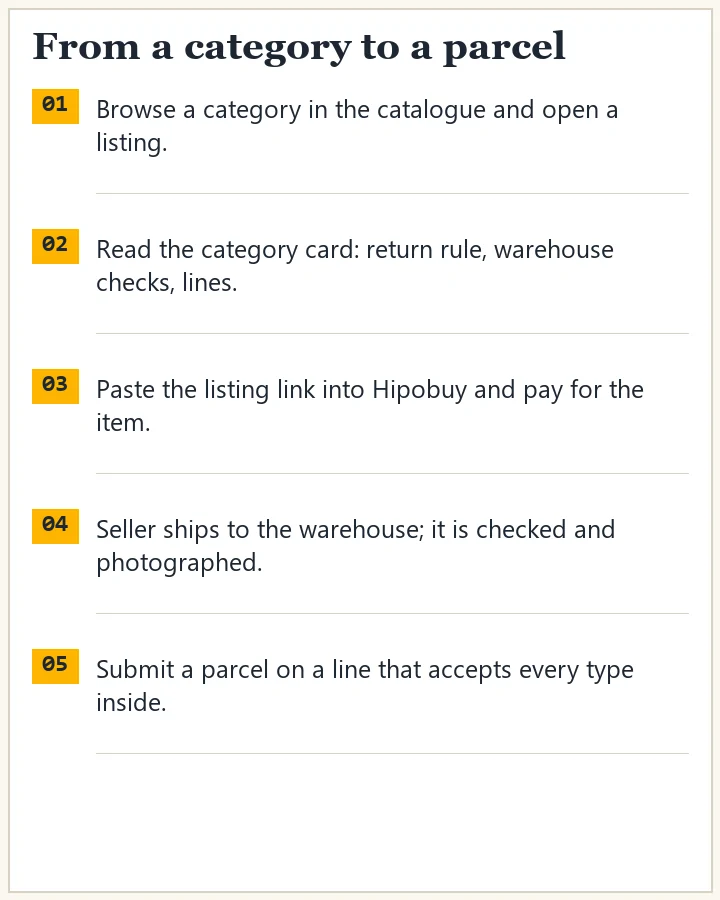
A spreadsheet in this sense is a set of product listings sorted into categories, each card linking to the listing in the catalogue. You browse, open a listing, copy its link and order it through an agent such as Hipobuy. The catalogue is the browsing step; the agent does the buying, the warehouse check and the shipping.
The cards here sit between those two steps. Before you paste a link into Hipobuy, the card tells you how Hipobuy treats that kind of item once it arrives. The drawer below is ordered by rule group, so all the categories that share a rule sit together.
All sixteen tiles
- Tag rule
 SneakersCC-01Category
- Seal rule
 PerfumeCC-02Category
- Device rule
 ElectronicsCC-03Category
- No extra row
 WatchesCC-04Category
- No extra row
 EyewearCC-05Category
- No extra row
 JewelleryCC-06Category
- No extra row
 BagsCC-07Category
- No extra row
 BeltsCC-08Category
- No extra row
 HatsCC-09Category
- No extra row
 Sports jerseysCC-10Category
- No extra row
 JeansCC-11Category
- No extra row
 SweatpantsCC-12Category
- No extra row
 T-shirtsCC-13Category
- No extra row
 HoodiesCC-14Category
- No extra row
 OuterwearCC-15Category
- No extra row
 WomenswearCC-16Search results
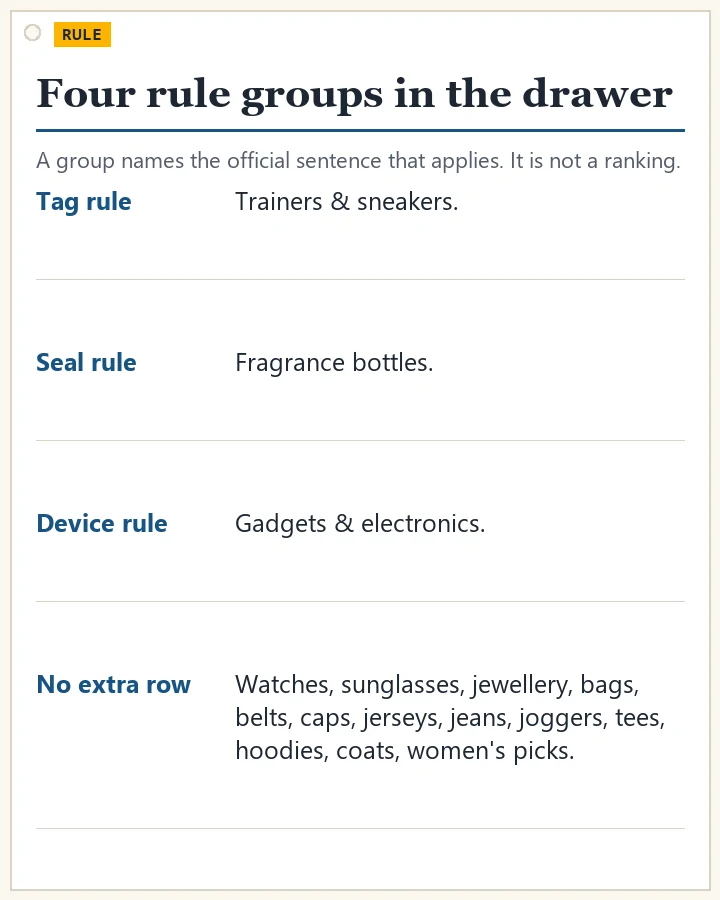
- Tag rule A named row in both intact tables: anti-theft tags and anti-tamper stickers stay on.
- Seal rule A named row: one-time sealed packaging stays unopened.
- Device rule A named row with device conditions: licence label intact, no liquid, limited use.
- No extra row No category row in either intact table; only the general exclusion list applies.
How each category maps to an estimator type
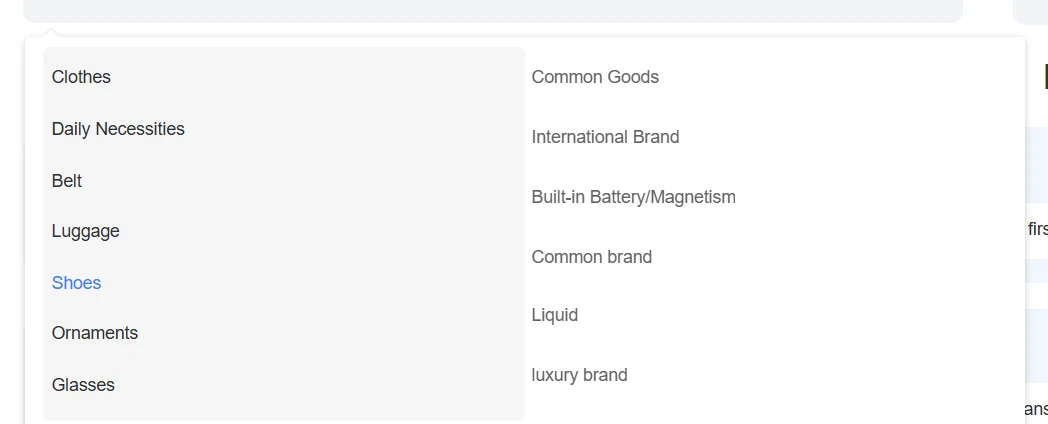
Hipobuy's estimator does not use catalogue categories. It has its own product-type menu with 21 groups, from Clothes and Shoes to Batteries and Dangerous goods, and each group has subtypes. The table shows the subtype this site used for each card. All are common-goods types; the brand-related subtypes in the same menu were not queried.
| Card | Estimator type used | Intact rule group | Tile opens |
|---|---|---|---|
| Trainers & sneakers | Shoes / Common Goods | Tag rule | Category |
| Fragrance bottles | Cosmetics / Perfume & Aromatherapy & Nail polish (below 100 ml) | Seal rule | Category |
| Gadgets & electronics | Electronics / Common Goods | Device rule | Category |
| Wristwatches | Watches / Common Goods | No extra row | Category |
| Sunglasses & frames | Glasses / Common Goods | No extra row | Category |
| Jewellery pieces | Ornaments / Common Goods | No extra row | Category |
| Bags & backpacks | Luggage / Common Goods | No extra row | Category |
| Belts & buckles | Belt / Common Goods | No extra row | Category |
| Caps & hats | Clothes / Common Goods | No extra row | Category |
| Sports jerseys | Clothes / Common Goods | No extra row | Category |
| Denim jeans | Clothes / Common Goods | No extra row | Category |
| Joggers & sweatpants | Clothes / Common Goods | No extra row | Category |
| Tees | Clothes / Common Goods | No extra row | Category |
| Hooded sweatshirts | Clothes / Common Goods | No extra row | Category |
| Coats & jackets | Clothes / Common Goods | No extra row | Category |
| Women's picks | Clothes / Common Goods | No extra row | Search |
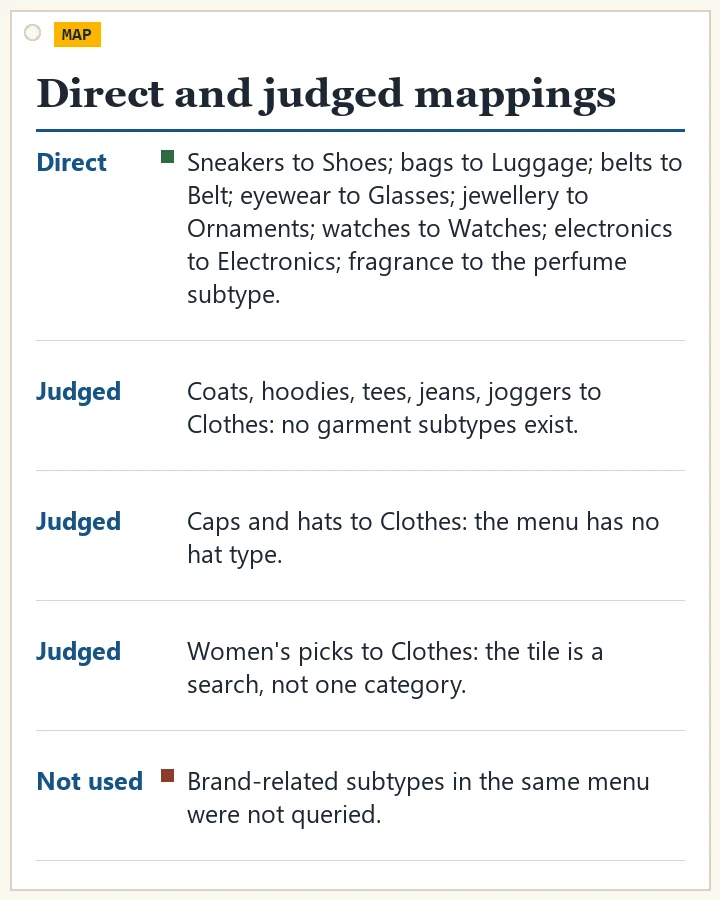
Three mappings are judgement calls and are marked on their cards. Hats have no estimator type, so they use Clothes. Jerseys and the women's picks tile also use Clothes. Everything else had an obvious home: Shoes, Luggage, Belt, Glasses, Ornaments, Watches, Electronics and the perfume subtype under Cosmetics.
The screenshot shows the estimator menu with the Shoes group open: Common Goods, International Brand, Built-in Battery/Magnetism, Common brand, Liquid and luxury brand. The card for sneakers uses the first, with the battery and liquid subtypes as toggles.
A category is a starting question, not an approval
Use the product card to reach the original listing, then identify the item’s actual features. A watch might contain a battery; a bag may include a liquid accessory; a jacket may be customised. These details can matter more than the broad shelf name. Select the relevant features in the rule card and compare its explanation with the agent’s current response for your item.
Record the exact seller link, chosen version, quantity and measurements before copying the request into Hipobuy. If the selected version changes, repeat the checks. Neither the Spreadsheet category nor a favourable result in this local tool reserves stock, confirms authenticity or creates a shipping quote. The tool helps you ask a precise question before money and packing decisions become harder to reverse.
Why the mapping is this site's and not Hipobuy's
Hipobuy never says that a hoodie listed in a catalogue equals Clothes / Common Goods in its estimator. That link is an editorial step, so the cards label it as ours. If you are unsure which type your item is, the estimator itself is the authority: pick the type there before you submit a parcel.
The same caution applies to the intact groups. Hipobuy's tables name product families such as Sports Shoes or Digital/Home Appliances. Matching a catalogue tile to those rows is again our reading, and the card pages quote the entry name so you can compare it with Hipobuy's wording.
Four rule groups in the drawer
The yellow tab on each tile names one of four groups. The tag group holds sneakers only. The seal group holds fragrance. The device group holds electronics. The fourth group, no extra row, holds the other thirteen categories, whose returns depend only on the general exclusion list and the seller.
The grouping says which official sentence applies. It does not say a category is safer or riskier; a plain tee can still be refused by a seller, and a sealed perfume can still come back if the seal is intact.